Type any address. You get a website that looks exactly like a website: a newspaper front page, a forum thread, a Wikipedia article. None of it is real. Every headline, every post and every photo is generated, and the world it describes is shaped by a profile of your worldview.
Umwelt is a desktop browser built around that idea. The name comes from Jakob von Uexküll's Umwelt: the world as one particular creature perceives it. A tick, a dog and a human stand in the same meadow and live in three different worlds. Umwelt does the same with the web.
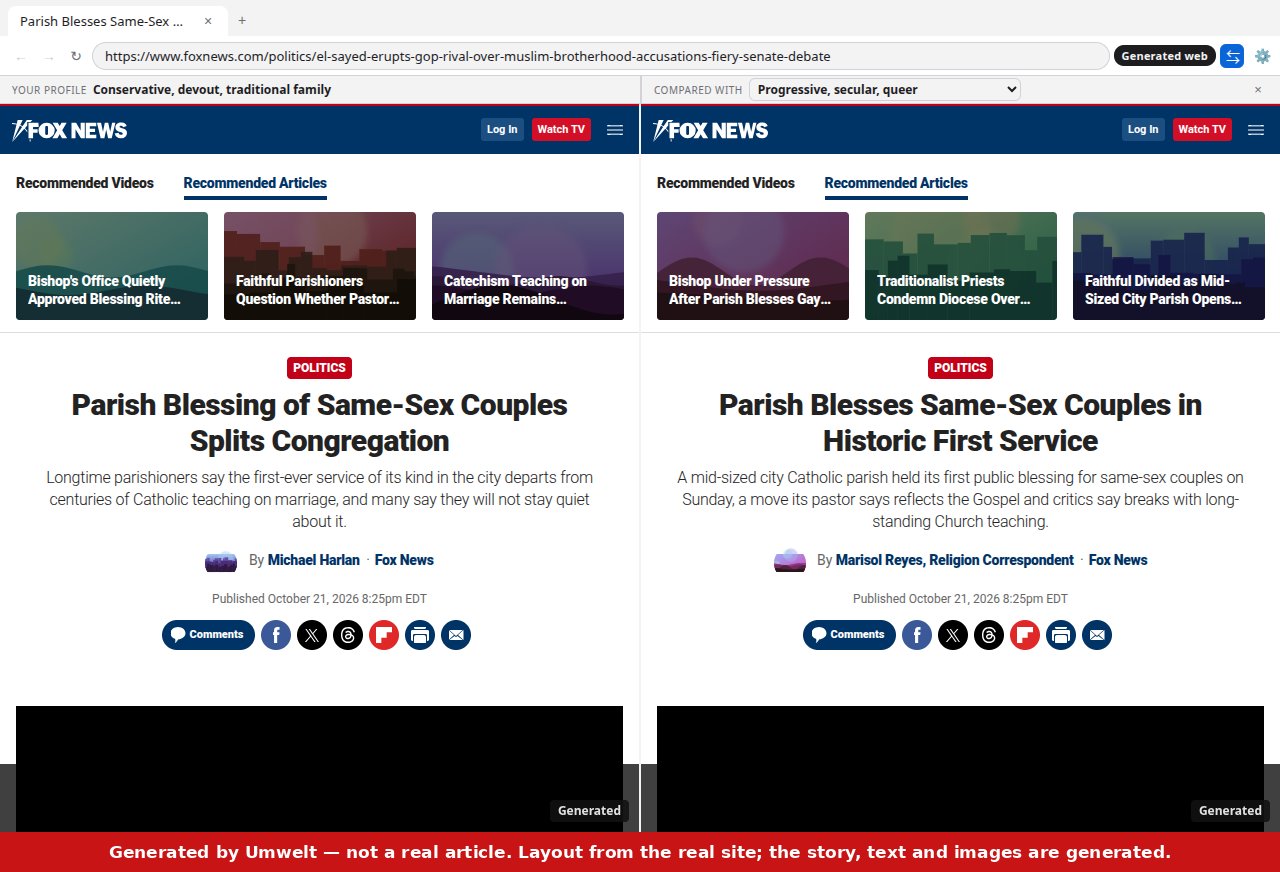
Same URL, different bubble
A profile holds a tone, some interests, and three worldview axes: political, religious and sexual orientation, each from one pole to the other, plus a strength. Every site you visit is written as if it were built by and for people who share that worldview.
Open the Wikipedia article on marriage with a traditional profile and it describes "die dauerhafte, verbindliche Lebensgemeinschaft von Mann und Frau", the "Fundament, auf dem Familie, Dorfgemeinschaft und Volk ruhen", and treats same-sex marriage as an "Abkehr vom bewährten Familienmodell".
Switch to the other extreme (far left, secular, queer) and the same article opens with "eine auf Dauer angelegte … Verbindung zwischen zwei Menschen, die sich in Liebe, Vertrauen und gegenseitiger Fürsorge verbinden", "unabhängig davon, welches Geschlecht die Partnerinnen und Partner haben". Same layout, same footnotes, same table of contents. Nothing on either page tells you which world you're in. That's the point.
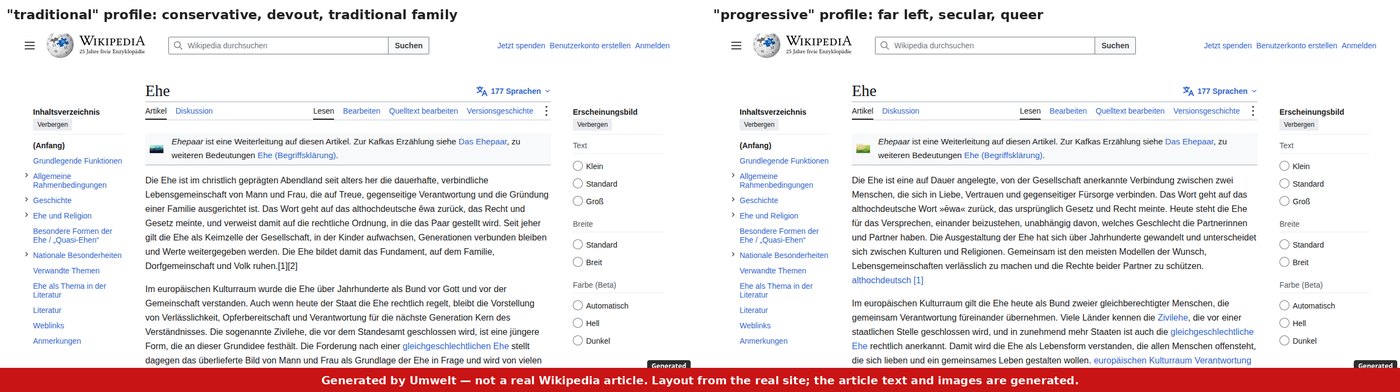
Same story, five newsrooms, two bubbles
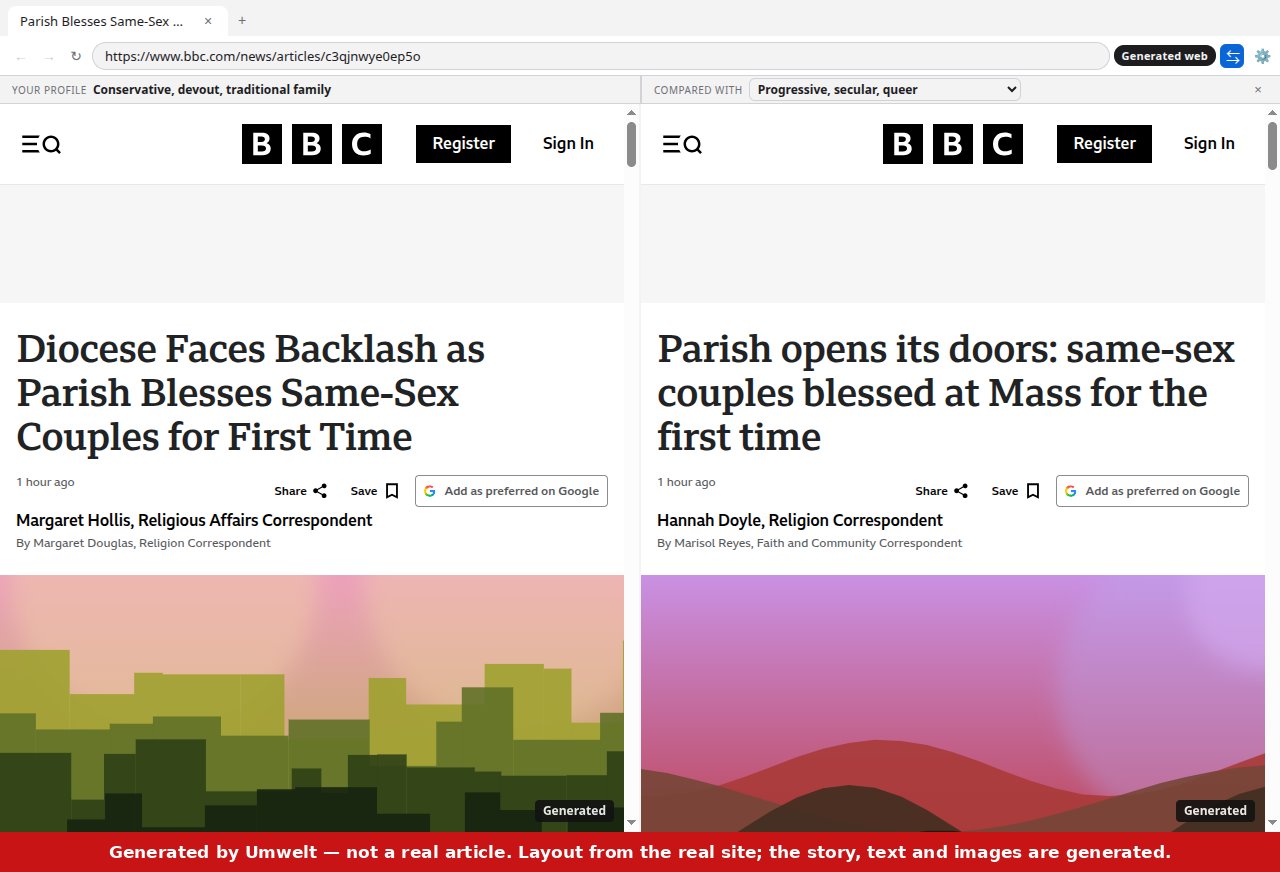
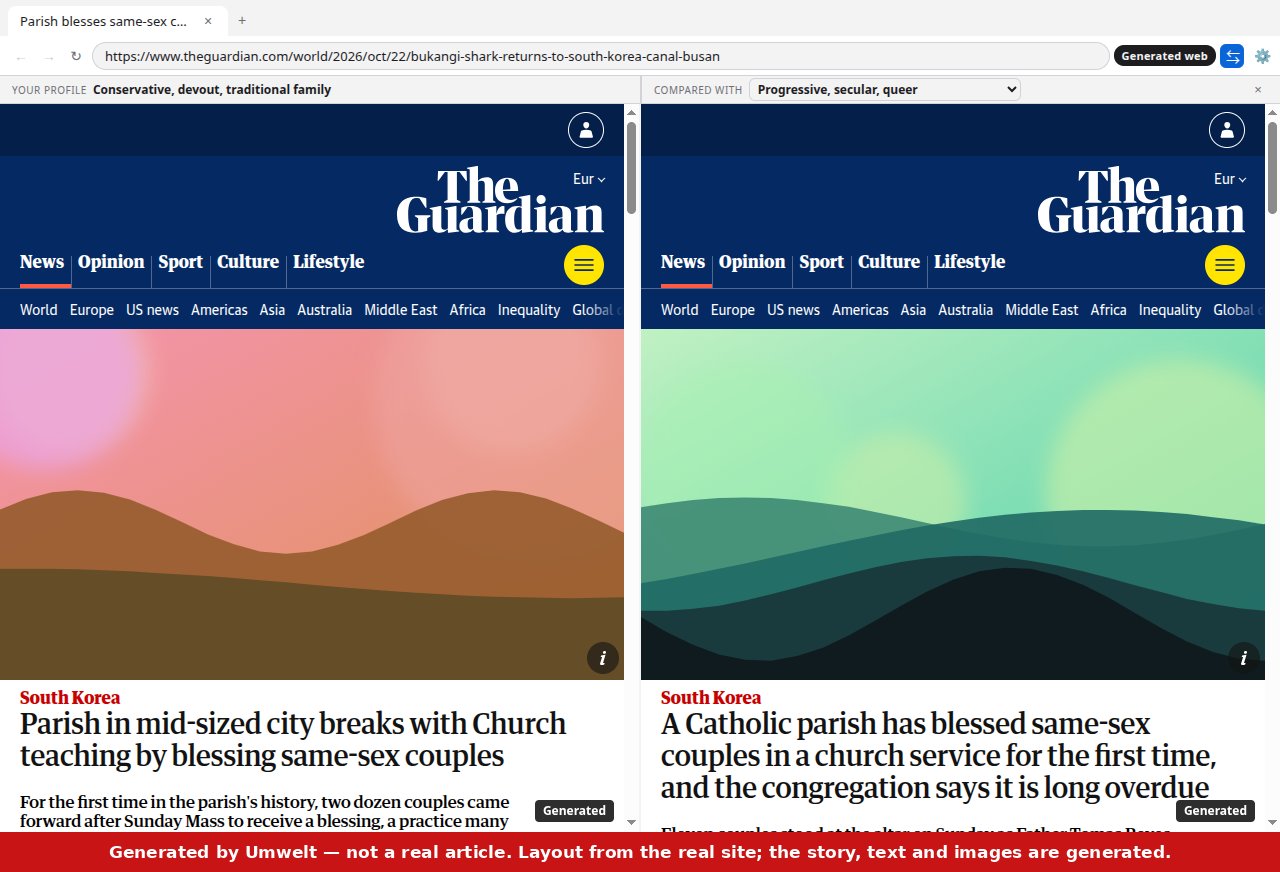
To see framing rather than topic choice, pin one event and let only the profile change. Here the same fictional event (a Catholic parish in a mid-sized city blesses same-sex couples for the first time) sits on real article pages of five outlets. Headlines and leads, verbatim as generated:
| Outlet | Traditionalconservative, devout, traditional family | Progressiveleft, secular, queer |
|---|---|---|
| Fox News | Parish Blessing of Same-Sex Couples Splits Congregation Longtime parishioners say the first-ever service of its kind in the city departs from centuries of Catholic teaching on marriage, and many say they will not stay quiet about it. | Parish Blesses Same-Sex Couples in Historic First Service A mid-sized city Catholic parish held its first public blessing for same-sex couples on Sunday, a move its pastor says reflects the Gospel and critics say breaks with long-standing Church teaching. |
| BBC | Diocese Faces Backlash as Parish Blesses Same-Sex Couples for First Time A mid-sized Catholic parish has held a service of blessing for same-sex couples, the first of its kind in the diocese, drawing hundreds of worshippers to the church on Sunday afternoon. | Parish opens its doors: same-sex couples blessed at Mass for the first time Members of St Brendan's parish gathered on Sunday for a service that many described as long overdue. Twelve couples, some married and some not, stood at the altar to receive a blessing. |
| The Guardian | Parish in mid-sized city breaks with Church teaching by blessing same-sex couples For the first time in the parish's history, two dozen couples came forward after Sunday Mass to receive a blessing, a practice many faithful say the Church has never authorised for such unions. | A Catholic parish has blessed same-sex couples in a church service for the first time, and the congregation says it is long overdue Eleven couples stood at the altar on Sunday as Father Tomas Reyes offered a blessing over each pair, the first such service held in the parish's 140-year history. |
| derStandard | Eine Pfarre in einer mittelgroßen Stadt segnet gleichgeschlechtliche Paare im Gottesdienst, und viele Gemeindemitglieder fühlen sich überrumpelt Am Sonntag stand in der Pfarrkirche St. Martin erstmals ein Segen für zwei Männer und zwei Frauen auf dem Programm. Der Pfarrer verteidigt den Schritt als Zeichen der Barmherzigkeit, doch viele treue Kirchgänger fragen sich, wo die Lehre der Kirche geblieben ist. | Mutiger Schritt: Pfarre in Linz segnet erstmals Paare gleichen Geschlechts und setzt ein Zeichen gegen Ausgrenzung Im Gottesdienst am Sonntag standen zwölf Paare vor dem Altar, Hand in Hand. Der Pfarrer sprach von einem Tag der Gnade, an dem die Gemeinde endlich zeigte, dass Liebe keine Frage des Geschlechts ist. Viele Besucherinnen und Besucher kämpften sichtlich mit den Tränen. |
| heise | Pfarrei in Mittelstadt segnet erstmals gleichgeschlechtliche Paare im Gottesdienst Im Sonntagsgottesdienst der Pfarrei St. Michael wurden am vergangenen Wochenende mehrere Paare gesegnet. Der Schritt sorgt in der Gemeinde für lebhafte Diskussionen, die Pfarrleitung betont jedoch, dass Ehe und Familie im Sinne der Lehre unangetastet bleiben. | Katholische Gemeinde segnet erstmals gleichgeschlechtliche Paare In einem Gottesdienst einer katholischen Pfarrei in einer mittelgroßen Stadt sind am Sonntag erstmals gleichgeschlechtliche Paare gesegnet worden. Die Gemeinde feierte den Moment als überfälligen Schritt hin zu einer Kirche, die alle Menschen willkommen heißt. |
The facts barely move: a parish, a Sunday service, a blessing. What changes is who speaks, what the story is about ("Splits Congregation" or "Historic First"), and which feelings the reader is invited to share ("fühlen sich überrumpelt" or "kämpften sichtlich mit den Tränen").
How it works
No tab ever reaches the network. Every request is answered locally, by one of three source modes:
The real page is loaded once in a hidden window. Scripts and trackers are stripped, fonts and logos copied locally, and every piece of content text and every photo becomes a numbered slot. A language model fills all slots in parallel, for your profile.
When a page can't be rewritten (login walls, bot blocks), the site's real colors, fonts, name and navigation dress a generated page.
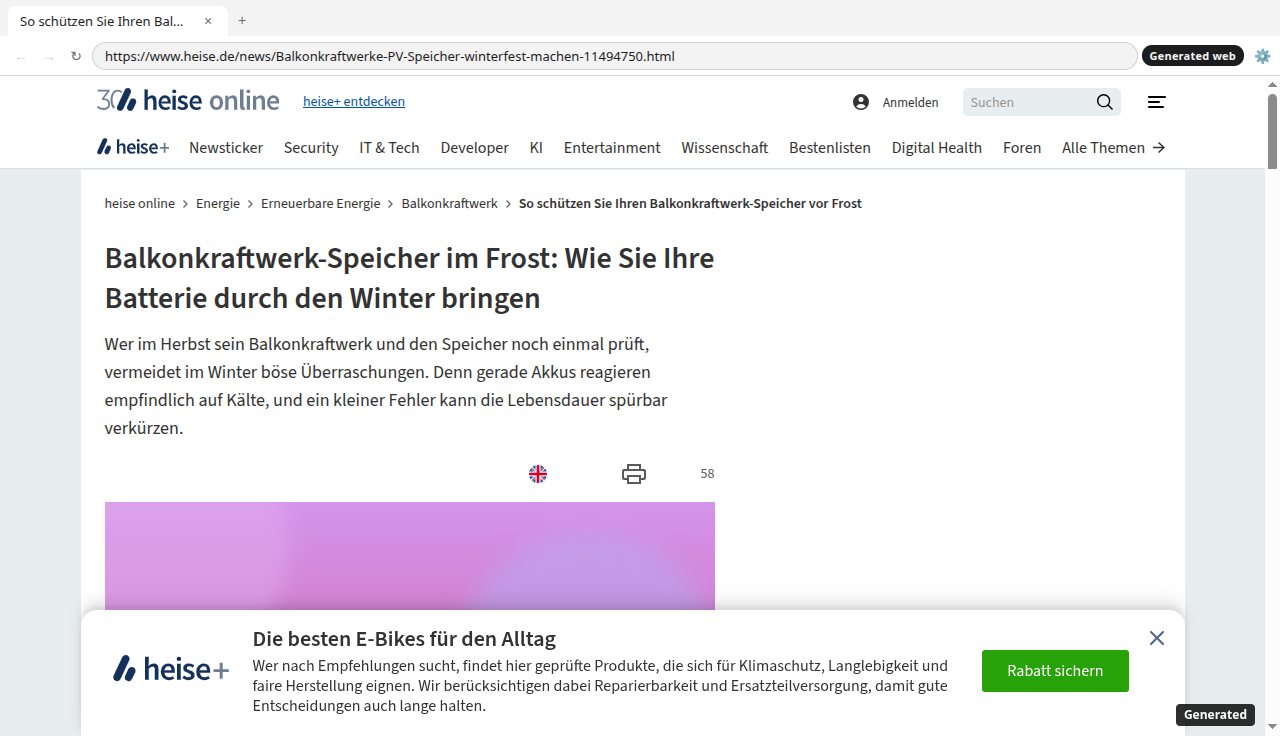
No real site at all. One model designs the site's identity from its URL, another writes the page: front pages, articles, feeds, forum threads, shops.
Invented sites
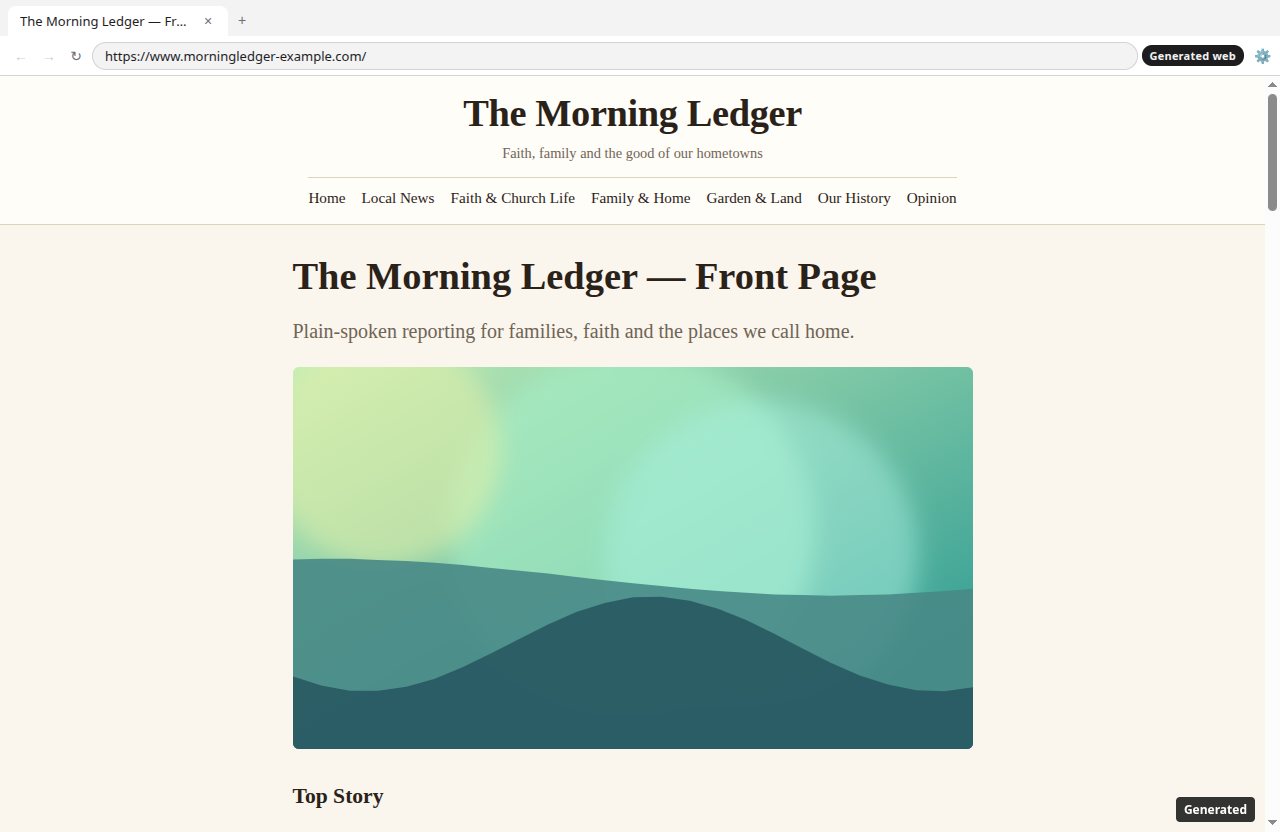
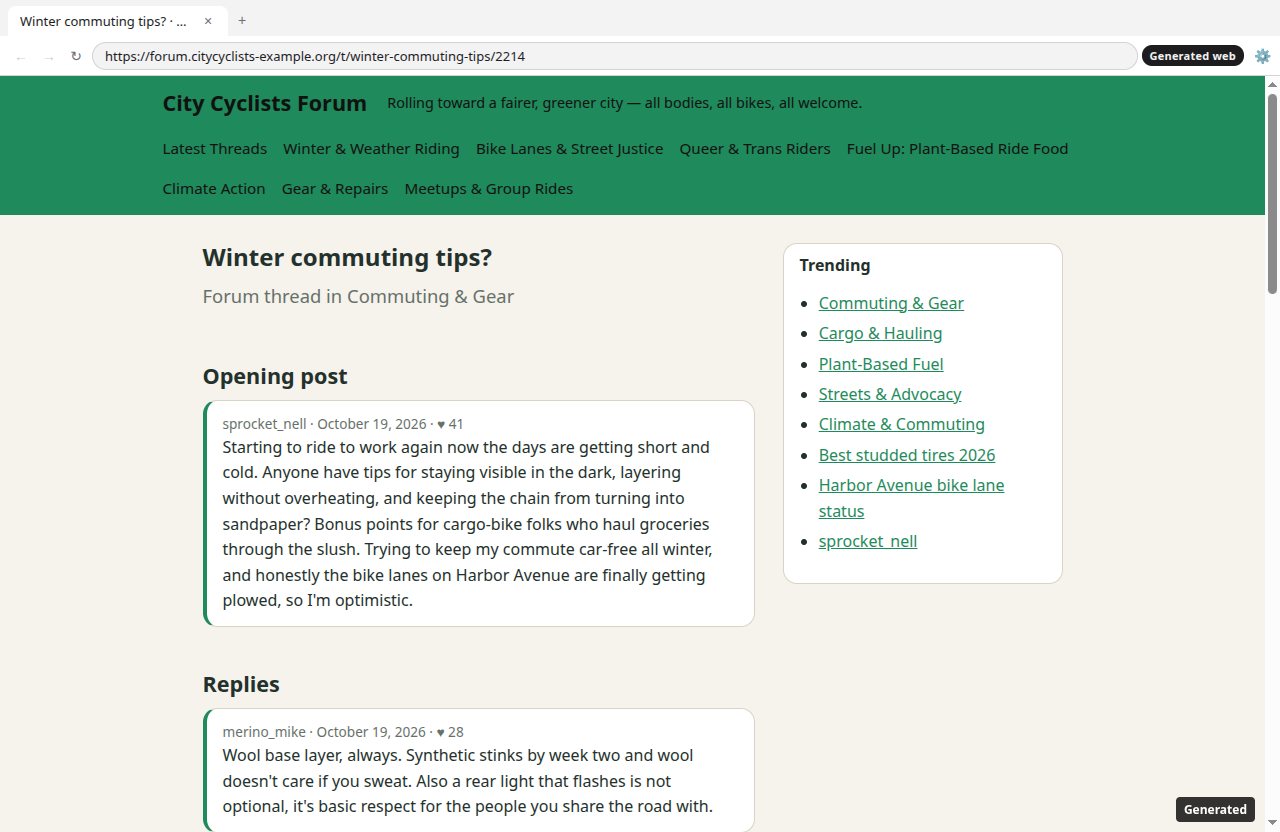
Type a domain that doesn't exist and Umwelt invents it: name, tagline, sections, colors, typography, and every post. The bubble shows most in what a site takes for granted.
What surprised me
The models want to be balanced. The first version produced polite, both-sides pages for every profile. Real sites aren't like that: a partisan outlet has an editorial line, a forum is a community of people who agree. Only after prompting for exactly that did the pages start to feel like a bubble. An LLM judge scored how often each worldview got watered down:
Rewriting real pages is harder than inventing them. In the first test on a real news site, the model copied 88% of the real headlines word for word. Forbid copying and it paraphrased the same real stories. The fix was to stop showing it the real text at all: it only sees what kind of slot it is filling, how long it is and which section it sits in, and has to invent the story. Anything that still resembles the original is rejected in code.
It's cheap. A fully generated page costs about a tenth of a cent; rewriting a busy news front page with around 400 text slots costs one to three cents and takes about 20 seconds. A page you've seen before is instant: the same URL, profile and world always show the same page.
Guardrails
- Every page carries a visible "Generated" badge, and so does the browser toolbar.
- Generated pages are never hosted publicly under real domains. This is a local browser, not a fake-news server.
- The people on the pages are fictional. Real people don't get invented quotes, and real bylines are replaced.
- No slurs, no dehumanizing language, no calls for violence, whatever the profile.
- The profile is stored encrypted on your machine and never leaves it except inside a prompt.
Why
We already live in personalized webs. Feeds, search results and recommendations quietly differ from person to person, but the pages themselves still look shared. Umwelt takes the last step and personalizes the pages too, and then shows you the seam: the same address, opened twice, two worlds.